
A Celebration 50 Years in the Making
Smokey Bear Historical Park in Capitan celebrates its 50th anniversary in 2026, honoring the iconic bear and his legacy of wildfire prevention across New Mexico and the nation.
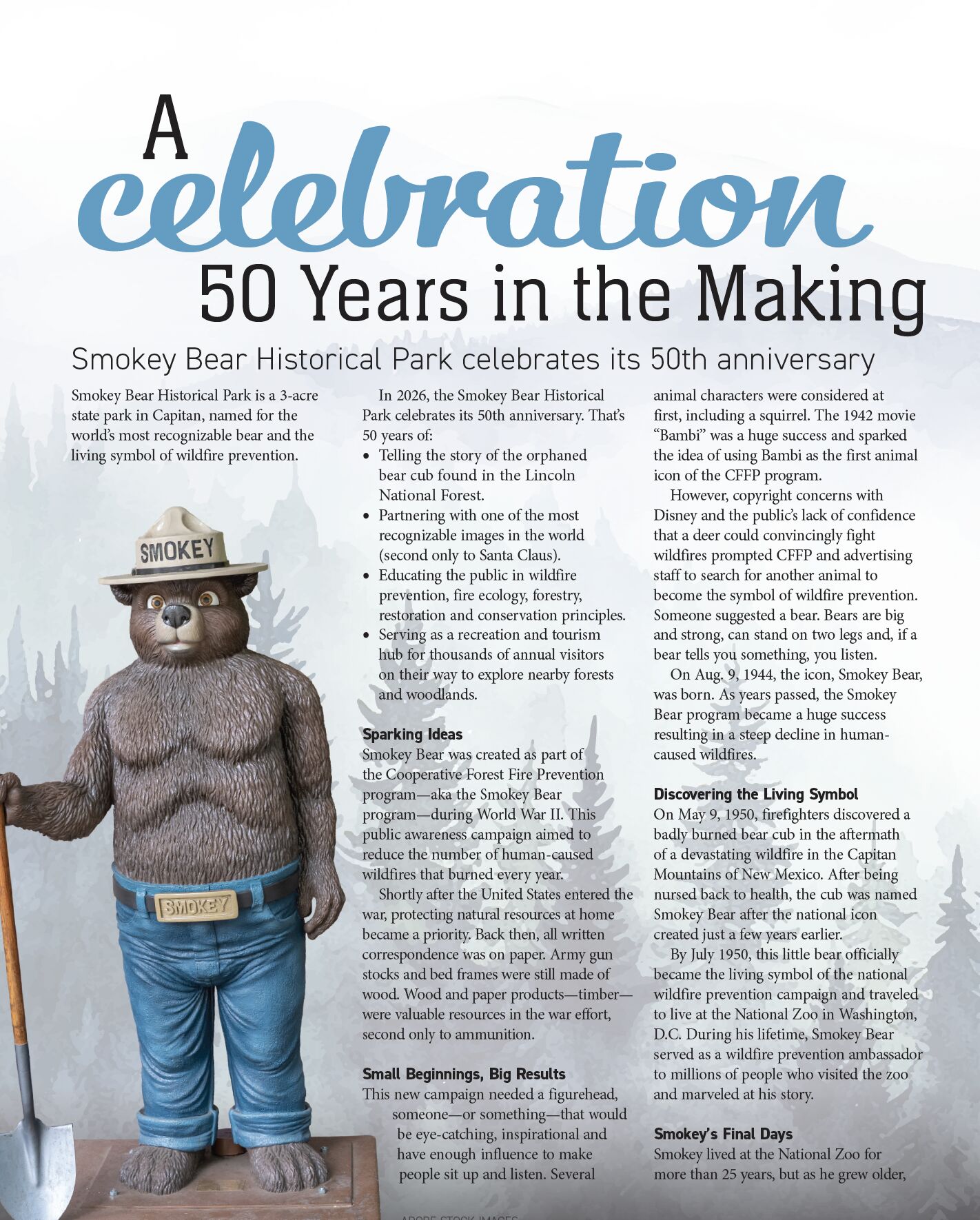
Smokey Bear Historical Park is a 3-acre state park in Capitan, named for the world's most recognizable bear and the living symbol of wildfire prevention.
In 2026, the Smokey Bear Historical Park celebrates its 50th anniversary. That's 50 years of:
- Telling the story of the orphaned bear cub found in the Lincoln National Forest.
- Partnering with one of the most recognizable images in the world (second only to Santa Claus).
- Educating the public in wildfire prevention, fire ecology, forestry, restoration and conservation principles.
- Serving as a recreation and tourism hub for thousands of annual visitors on their way to explore nearby forests and woodlands.
Sparking Ideas
Smokey Bear was created as part of the Cooperative Forest Fire Prevention program—aka the Smokey Bear program—during World War II. This public awareness campaign aimed to reduce the number of human-caused wildfires that burned every year.
Shortly after the United States entered the war, protecting natural resources at home became a priority. Back then, all written correspondence was on paper. Army gun stocks and bed frames were still made of wood. Wood and paper products—timber—were valuable resources in the war effort, second only to ammunition.
Small Beginnings, Big Results
This new campaign needed a figurehead, someone—or something—that would be eye-catching, inspirational and have enough influence to make people sit up and listen. Several animal characters were considered at first, including a squirrel. The 1942 movie "Bambi" was a huge success and sparked the idea of using Bambi as the first animal icon of the CFFP program.
However, copyright concerns with Disney and the public's lack of confidence that a deer could convincingly fight wildfires prompted CFFP and advertising staff to search for another animal to become the symbol of wildfire prevention. Someone suggested a bear. Bears are big and strong, can stand on two legs and, if a bear tells you something, you listen.
On Aug. 9, 1944, the icon, Smokey Bear, was born. As years passed, the Smokey Bear program became a huge success resulting in a steep decline in human-caused wildfires.
Discovering the Living Symbol
On May 9, 1950, firefighters discovered a badly burned bear cub in the aftermath of a devastating wildfire in the Capitan Mountains of New Mexico. After being nursed back to health, the cub was named Smokey Bear after the national icon created just a few years earlier.
By July 1950, this little bear officially became the living symbol of the national wildfire prevention campaign and traveled to live at the National Zoo in Washington, D.C. During his lifetime, Smokey Bear served as a wildfire prevention ambassador to millions of people who visited the zoo and marveled at his story.
Smokey's Final Days
Smokey lived at the National Zoo for more than 25 years, but as he grew older, his health declined. The folks of Capitan wanted Smokey Bear returned home once he passed away. More than 3 acres of land were donated to New Mexico State Parks to create a space that could honor his memory and continue telling his story of wildfire prevention.
The Smokey Bear Historical Park was dedicated May 15, 1976.
Smokey Bear died later that year on Nov. 9. His body was flown from Washington, D.C., to Capitan the following day and buried on park grounds at 3 a.m.—but that's another story.
Smokey Bear Historical Park's Mission
Since 1976, Smokey Bear Historical Park has shared Smokey's message of preventing human-caused wildfires through its museum exhibits and outdoor interpretive gardens, while not forgetting there are other stories to tell as well.
The park's mission is big: Staff continue to share the true story of Smokey Bear via educational programs and by talking with guests about wildfire science, ecology, resource conservation, sustainable forestry practices and hazardous fuels management.
Museum exhibits explore how visitors can work, live and play safely in the wildland-urban interface, which is where forested areas bump up against humans and their homes and neighborhoods. Interpretive displays explain the importance of protecting and restoring watersheds in Southwestern ecosystems, and how practices, such as the traditional use of fire by Indigenous people and prescribed burns, can play a part in reducing hazardous fuels and restoring New Mexico's landscapes.
Smokey Bear Days
Since 2005, Smokey Bear Historical Park has partnered with a nonprofit friends group, the Smokey Bear's Hometown Association, to host an annual two-day conservation education event called Smokey Bear Days.
The 2026 Smokey Bear Days event is a special occasion that honors the park's 50th anniversary. This fun-filled, family-friendly event boasts plenty of fire prevention and natural resource exhibits and conservation presentations, as well as a hometown parade and the annual firefighter challenge. It wouldn't be complete without food, vendors, family-friendly games and more.
"Thanks for listening and remember: Only you can prevent wildfires!"
To learn more about Smokey Bear's story, the 2026 Smokey Bear Days event, park hours of operation and entrance fees, visit www.emnrd.nm.gov/sfd/smokey-bear-historical-park.
Photo captions (clockwise from top left): Smokey and Homer Pickens, assistant warden at New Mexico Department of Game and Fish, pose in June 1950 next to the specially painted Piper Pacer airplane that would fly them to the nation's capital and Smokey's new home at the National Zoo. Smokey Bear walks on the fuselage of a New Mexico Department of Game and Fish airplane in May 1950. Young Smokey Bear poses under a CFFP campaign poster. Warden Ray Bell gives Smokey a refreshing drink. Homer and Smokey are welcomed June 30, 1950, with a reception at the National Zoo in Washington, D.C. Photos courtesy of the Forest History Society.