The Journey to Jupiter
The Journey to Jupiter
By Alan Hale
Almost all of our planetary viewing during February will take place in the evening sky.
Related Issue:

By Alan Hale
Almost all of our planetary viewing during February will take place in the evening sky.
By Alan Hale
The new year begins with the brilliant planet Venus gleaming brightly in our western evening sky.
By Alan Hale
For the past few months, our sister planet, Venus, has been engaged in a slow climb into our evening sky. But, for most of that time, it has been buried fairly deep in twilight.
By Alan Hale
Our September evening skies feature a growing presence of our fellow planets. Venus continues its very gradual ascent out of the twilight and, by the end of the month, sets around dusk. Saturn, meanwhile, is at opposition—directly opposite the sun in the sky on Sept. 7.
By Alan Hale
The new year opens with our solar system’s two largest worlds shining brightly in our evening sky. Saturn is in the southwestern sky and sets one to two hours after the end of dusk.
By Alan Hale
Slowly but surely, planets are returning to our evening skies. Venus continues its gradual ascent into the western sky, although it remains deep in the dusk throughout August.
For the past few months, our evening skies have been entirely devoid of bright planets, but that comes to an end during July.
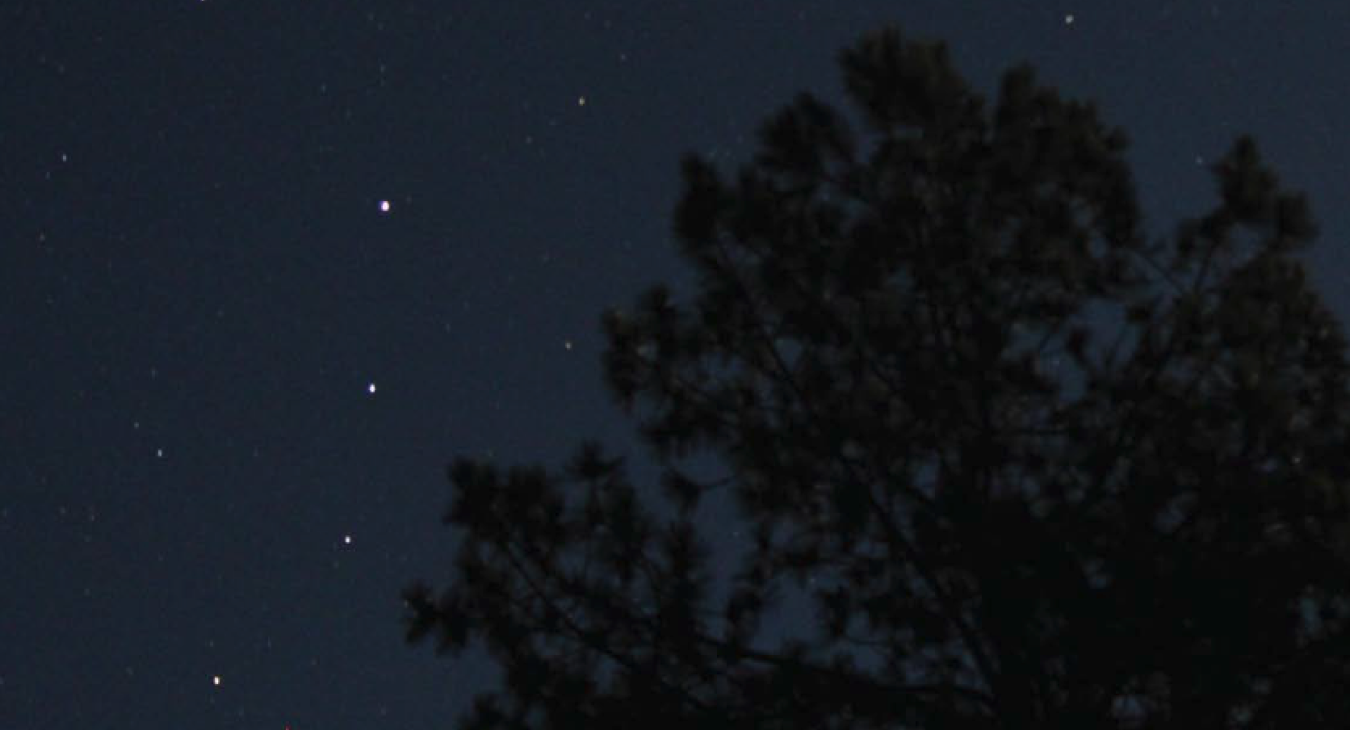
The constellation Corona Borealis, known as the Northern Crown, is visible arcing just to the left of the foreground tree. The location of the recurrent nova, T Coronae Borealis, is indicated in red. If/when this star explodes, it may briefly become as bright as Alphecca, the star near the center of the crown's arc and the brightest star in Corona Borealis.
Our evening skies are almost totally devoid of bright planets during May and June. The planetary action has shifted entirely to the morning sky. The first planet to appear is Saturn, well up in the eastern sky during the pre-dawn hours and rising around midnight by the end of June.
Total eclipse of the sun on February 26, 1979, from Southern Manitoba, Canada. The sun’s extensive outer atmosphere—or corona—is visible, along with a couple of prominences—large loops of ionized gas. PHOTO BY ALAN HALE
The top celestial event during April will be the solar eclipse on Monday, April 8. The eclipse will be total—the moon will completely block the sun—along a path that crosses north-central Mexico and central Texas, then continues across the midwestern and northeastern U.S.
The planetary show we’ve been enjoying in the evening sky since the latter part of 2023 still has a few more months to run, although only a few planets remain visible. The primary performer is Jupiter, which is high in the western sky at the end of dusk and sets an hour or so before midnight.