
A Comet, A Calling, A Form of Immortality
Part two of a two-part feature on Dr. Alan Hale of Cloudcroft, NM — co-discoverer of Comet Hale-Bopp. In this installment, Tom Condit explores the comet's scientific significance, the global media storm it created, Alan's science diplomacy in Iran and Lebanon, and his reflections on legacy, time, and a form of immortality few humans will ever know.
This is part two of a two-part feature on Dr. Alan Hale. Last month, we explored Hale's early life, scientific career and the events leading to the discovery of Comet Hale-Bopp. In this installment, we look at the scientific significance of the comet, the global attention it generated, and Hale's reflections on legacy and time.
When Comet Hale-Bopp was first discovered, there was nothing to suggest it would become anything extraordinary. It looked just like the other comets Alan Hale had seen.
That changed in early August 1995. The first viable orbital calculations became available that year and showed that the comet was still approximately a year and a half away from its closest approaches to the sun and Earth. Combined with its relatively bright appearance at discovery, this indicated a high intrinsic brightness and suggested the potential that it could become a very bright comet.
As time passed, it became increasingly clear Hale-Bopp would indeed become a major astronomical event. Its early discovery provided scientists with an unusually long lead time to plan observations. At the time, most comets were discovered only months before their closest approach.
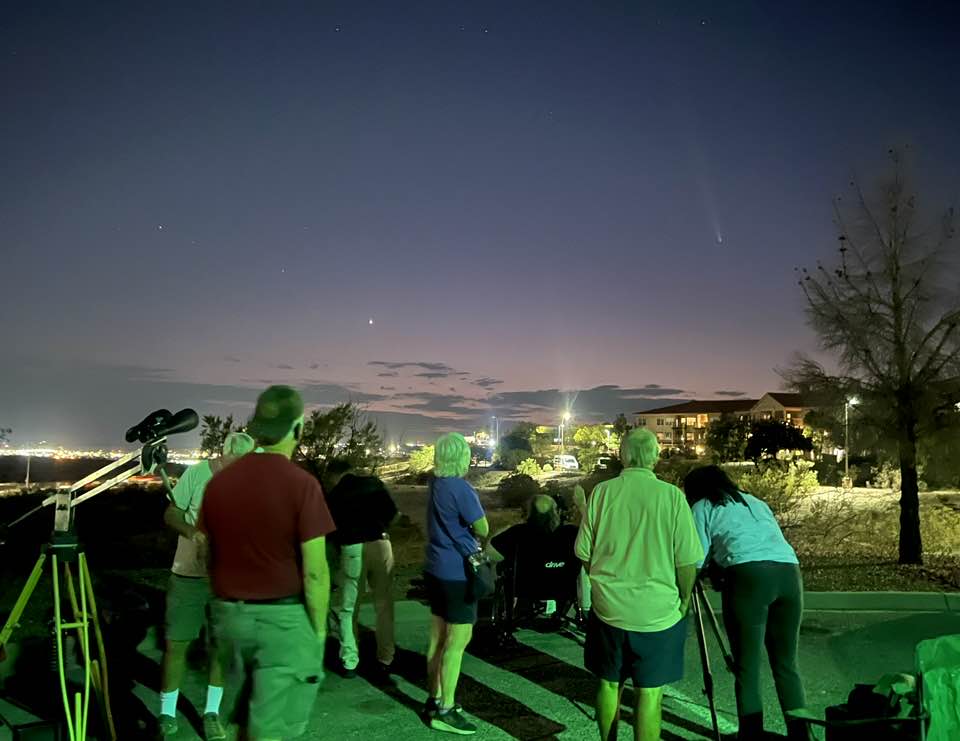
In 1997, Hale-Bopp was visible for an extended period and was seen by more people than any other comet in recorded history.
"The knowledge that people around the world could see this comet — and know that my name was on it — is a feeling that is hard to describe," Alan says.
Hale-Bopp is one of the largest comets ever observed. If all comets could be viewed under identical conditions — at the same distance from the sun and Earth — Hale-Bopp would rank among the brightest ever seen in history.
Global Attention and Media
When Hale-Bopp was discovered in 1995, there was an initial flurry of publicity. That attention subsided within a few weeks.
Public and media interest grew again a year later, peaking in 1997, as it became increasingly likely Hale-Bopp would become a bright, widely visible comet.
Alan's first interactions with the media were positive. Science reporter John Fleck of the Albuquerque Journal took great care to verify details, calling multiple times to ensure accuracy before publishing.
However, not all media representatives approached the story with the same level of diligence. Some misunderstood or misrepresented facts, even after repeated explanations.
At times, the attention became overwhelming. Alan received numerous phone calls, including early morning calls from East Coast radio stations that did not account for time zone differences. Eventually, he disconnected the ringers on his phones at night.
When news broke of the Heaven's Gate mass suicide — where a cult believed the Hale-Bopp comet was an alien spaceship they could board by dying — the volume of media inquiries became so intense that Alan stopped answering individual calls and instead organized a press conference the following day. The turnout — particularly in a small town like Cloudcroft — was remarkable. He held the press conference at The Lodge, which subsequently benefited from the influx of visiting media representatives.
Among the more frustrating aspects of media attention were questions that assumed conflict between Alan and Thomas Bopp over their simultaneous discoveries of the comet and it being named after both of them. Alan has always rejected that narrative.
Both discoveries were legitimate. Both individuals independently observed the object, followed up appropriately and reported it according to established procedures.
"Our names both belonged on it," Alan says.
Personal Impact and Opportunities
The discovery of Hale-Bopp significantly changed Alan's life, both professionally and personally.
It provided him with what he describes as a "career," even if it differed from the traditional scientific path he had originally envisioned. Through his organization, Earthrise Institute, he was able to raise funding to support scientific and educational activities, including involvement in spacecraft missions. The visibility of the comet opened doors to teaching opportunities, including work with the American Public University System and the International Space University.
It also led to extensive travel and experiences for Alan and his family. These included trips to New York and Washington, D.C., where Alan met with members of Congress and officials with the Clinton administration. He also participated in a private comet-viewing session at the U.S. Naval Observatory with Vice President Al Gore and his wife, Tipper.
Other experiences included a three-week visit to Australia, a solar eclipse cruise in the Caribbean and a trip to Africa to observe another eclipse.
Alan attended an educational fundraising event in Los Angeles, where he met individuals from the scientific and entertainment communities, including Patrick Stewart, Morgan Freeman and James Cameron, who shared how Hale-Bopp played a role in the filming of "Titanic."
Alan also spoke at a "Star Trek" convention and met individuals associated with the franchise that had influenced his early interest in space.
Perhaps most meaningful to Alan were his "science diplomacy" efforts. In collaboration with organizations such as Search for Common Ground, he participated in expeditions to Iran in 1999 and 2000, engaging directly with students and communities. In 2009, he traveled to Lebanon to speak with high school students during the International Year of Astronomy.
In recognition of these efforts, Alan was named a State Finalist for the "Above and Beyond" Citizens Award presented by the U.S. Congressional Medal of Honor Society.
He considers that recognition especially meaningful, as it acknowledged his efforts to use the opportunities created by the comet discovery to contribute positively to society.
Lessons and Perspective
Alan isn't sure if Hale-Bopp taught him anything about patience and perseverance.
He spent years conducting systematic comet searches, only to stop those efforts in 1992. Three years later, he discovered Hale-Bopp not during a deliberate search, but while observing known objects.
However, he does identify an important lesson from an earlier experience. In the late summer of 1975, while lying in his front yard and observing the night sky, he noticed a star in the constellation Cygnus that did not match the pattern he remembered. After briefly examining it, he dismissed it.
The following day, the local newspaper reported the appearance of a bright nova — Nova Cygni 1975 — the brightest nova visible during his lifetime. Although he would not have received credit for its discovery even if he had followed up, the experience left a lasting impression. Since then, whenever he encounters something unusual, he takes the time to investigate it.
"While 99% of the time this will turn out to be something that has always been there, it's that other 1% that can make all the difference," Alan says.
Legacy and Reflection
Comet Hale-Bopp is expected to return in approximately 2,400 years. One published estimate suggests a return in August 4393, although such predictions carry uncertainty.
If human civilization still exists at that time, future generations may observe the comet and recognize its name.
"That gives me a form of immortality that few humans have or will ever achieve," Alan says.
Today, Alan remains active in scientific and educational efforts. Through Global Sky Partners — an educators' forum associated with the Las Cumbres Observatory — he participates in observational work and collaborates with educators around the world.
He has contributed to follow-up observations of newly discovered objects — including Comet 3I/ATLAS — and has recovered expected returning comets such as Comet 13P/Olbers.
Alan still lives in the Sacramento Mountains near Cloudcroft, not far from where he made his historic discovery.
Life has moved forward. He is happily remarried, and his two sons — who were young children at the time of the discovery — are grown and have families of their own.
Alan still enjoys observing the night sky, although health challenges have limited his ability to do so as extensively as in the past.
"But at least the phone doesn't ring all night anymore," he says.
Lessons Taught by Hale-Bopp
In addition to being one of the most-viewed comets in history, Hale-Bopp was the subject of much scientific study.
Comets, Alan Hale says, are the "leftovers" from the formation of the solar system. Studying them provides insight into planetary formation, including the origins of Earth and the delivery of materials necessary for life.
Technological advancements played a critical role in helping people learn from Hale-Bopp. Relatively new technology — such as electronic detectors, expanding internet communications and the ability to observe beyond visible light, including infrared, ultraviolet, microwave and X-ray wavelengths — allowed scientists to study the comet in ways that had not previously been possible.
A wide variety of substances were detected within Hale-Bopp, many for the first time in a comet. Numerous physical and chemical processes were analyzed in unprecedented detail. These findings helped clarify long-standing questions about the materials that may have been delivered to Earth early in its history — including water and organic compounds — and about the environments where comets are formed.
In early 1998, an entire scientific conference — The First International Conference on Comet Hale-Bopp — was devoted to the scientific results obtained from studying the comet.
Even decades later, scientists continue to observe Hale-Bopp. The most recent observations were obtained using the James Webb Space Telescope in July 2022, when the comet was farther from the sun than Pluto is on average.
The discovery of interstellar objects in recent years reinforces that similar processes occur throughout the galaxy. Meanwhile, the continued presence of comets and asteroids reminds us that planetary formation is ongoing and that impacts, while rare, are still possible.